Riester Savings or a Retirement Savings Account from 2027: When Does Switching Make Sense?


From 2027, the new Retirement Savings Account (Altersvorsorgedepot) will introduce a new form of state-subsidised private retirement provision. Existing Riester savers will be able to transfer their accumulated savings to the new scheme and benefit from the new system of government incentives.
Alternatively, existing Riester contracts can be continued under their current terms or no longer funded with new contributions. Whether switching is worthwhile depends on factors such as the terms of your current contract, the time remaining until retirement and your individual eligibility for government incentives.
One important point first: there is no need to rush your decision. You have until the end of 2027 to decide whether to switch and still benefit from the incentives for the full year.
The new Retirement Savings Account at a glance
The Retirement Savings Account combines government incentives with investment in the capital markets. It is available to employees and self-employed individuals. Civil servants and members of certain professional pension schemes may also qualify for the incentives. The government incentives include an annual basic allowance of up to 540 euros. An additional allowance of up to 300 euros is available for each child. Government incentives are available for annual contributions of between 120 euros and 1,800 euros.
You can invest your savings in funds, bonds and other eligible capital market investments. However, individual shares, certificates and cryptocurrencies are excluded. When investing your savings, you can choose from different risk categories. Higher potential returns are only possible if you take on greater risk. Your personal appetite for risk therefore plays an important role in choosing the right product. Ask yourself whether you would generally be comfortable if the value of your investments were to fall significantly from time to time.
The Standard Retirement Savings Account, also referred to as the Standard Account, is a version of the Retirement Savings Account designed for first-time investors. Your bank or another provider will offer a choice of two funds with different levels of risk. You can decide how much money you put in each fund or opt for your provider’s recommended standard allocation.
Charges, tax and withdrawals
A statutory annual fee cap of 1% applies to the Standard Retirement Savings Account. There is no statutory fee cap for other Retirement Savings Accounts. From 2027, details of the most important charges will be set out in the product information sheet provided by your bank or other provider.
The Retirement Savings Account also offers attractive tax advantages: During the savings phase, investment gains and portfolio rebalancing are not generally subject to ongoing taxation. The standard flat charge does not apply either. Tax only becomes payable during the withdrawal phase. This allows your investment returns to remain invested and continue growing during the savings phase.
When the withdrawal phase begins, you can choose between a withdrawal plan and a lifelong annuity. In addition, you’ll be able to make a one-off withdrawal of up to 30% of your accumulated savings at the start of the withdrawal phase. If you choose a withdrawal plan, it must generally be designed to provide payments until at least the age of 85.
Important to know: If you withdraw money from your Retirement Savings Account before the start of the withdrawal phase, you will be required to repay any allowances and tax benefits received. However, exceptions apply, for example if you transfer the funds to another eligible retirement savings product or use them to finance a home that you occupy yourself.
Consider your options
If you already have a Riester contract, you will generally have three options in future.
Continuing with your Riester contract
You can continue your Riester contract as before. In this case, the agreed terms and conditions of your contract will remain unchanged.
Transferring your Riester savings to a new Retirement Savings Account
You transfer your Riester savings to a new Retirement Savings Account. Your providers will handle the transfer process and inform you of any charges that may apply.
Charges may apply to the transfer. During the first five years of the contract, your current provider may charge a maximum of 150 euros for the transfer. After that, transfers are generally free of charge. Your new provider may also charge a one-off fee of up to 150 euros. Important: If you enter into a new retirement savings contract, you will move to the new government incentive scheme. You cannot receive government incentives under both the old and the new rules at the same time.
Stop paying in to your Riester contract and start saving into a Retirement Savings Account
You place your Riester contract on hold and start saving into a Retirement Savings Account instead. Your existing retirement savings remain in your Riester contract. Any new contributions qualify for the new government incentive scheme. This option of leaving your Riester contract dormant is expressly provided for under the new rules. Before making a decision, check how this option may affect the government incentives available to you.
Take a closer look at your existing Riester contract
Riester contracts can vary considerably in terms of charges, guarantees, annuity factors and retirement benefits. Older contracts may offer features and conditions that are no longer available in newer products. So, it’s worth taking a closer look at the benefits and guarantees included in your existing contract.
A newer product is not automatically a better one. Whether switching makes sense depends largely on how the terms of your existing contract compare with those of the new Retirement Savings Account.
Why timing matters
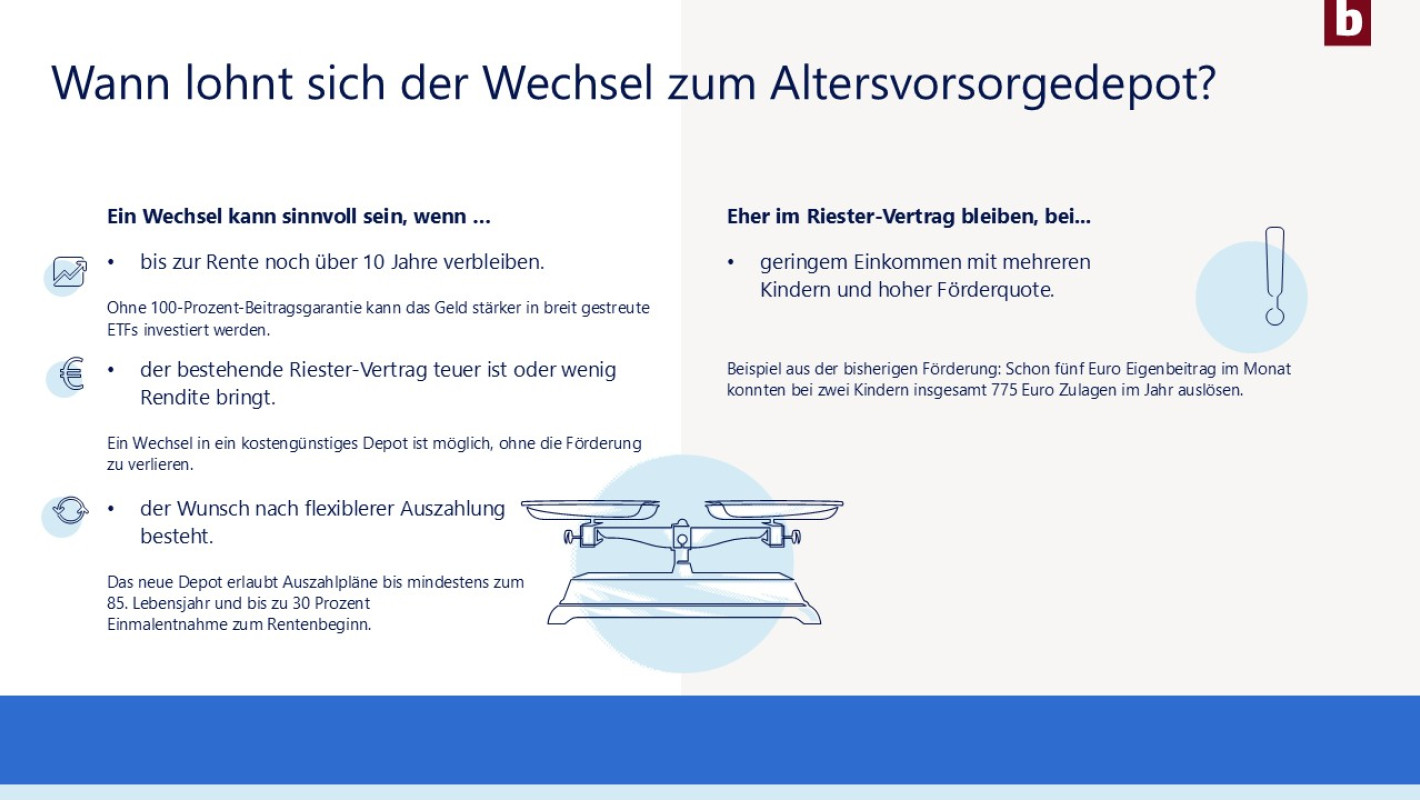
The amount of time you have left until retirement is an important factor when deciding whether to switch. Investments in the capital markets tend to perform best over longer periods. If you still have many years until retirement, you may be better placed to benefit from long-term growth opportunities and ride out short-term market fluctuations.
The closer you are to retirement, the more important the benefits and guarantees already built into your existing contract become. So, if you’re only a few years away from retirement, it’s particularly important to consider carefully how a switch could affect your existing benefits and guarantees. The time you have left until retirement is an important factor, but it’s not the only one.
Child allowances can make a difference
Government incentives should be one of the key factors in your decision. Many Riester savers receive child allowances. Depending on your income and the number of children you have, these government incentives can make up a significant proportion of your retirement savings. Families should therefore compare the incentives available under the current Riester system with those offered through the Retirement Savings Account. The differences can be particularly significant if you receive allowances for more than one child.
When switching makes sense
The Retirement Savings Account may be particularly attractive if you still have many years until retirement and would like to benefit from the long-term growth potential of capital market investments. If you already have a Riester contract or are only a few years away from retirement, it is important to weigh up carefully the advantages and disadvantages of switching. In particular, you should consider the following:
- The charges associated with your existing Riester contract
- The guarantees and retirement benefits it provides
- How long you have until retirement
- The impact on any child allowances you receive
- Any charges that may apply if you switch
- The charges and benefits offered by the new Retirement Savings Account
- Whether stopping paying contributions to your Riester contract could be an option
- The withdrawal options available under the new contract
Contact
Kathleen Altmann
Press spokeswoman