Best value-for-money summer holidays for German tourists in 2026

If you’re planning to travel abroad for your summer holiday, you need to budget for more than just the cost of flights and accommodation. You should also take a look at the purchasing power of your euros at your destination. In other words, what countries allow you to get the most out of your money?
A single euro has different values in different places. You’ll get more or fewer goods and services for your money depending on the country you visit. The greater the purchasing power of your euro abroad, the more you’ll be able to afford at your holiday destination, which directly effects your holiday budget.
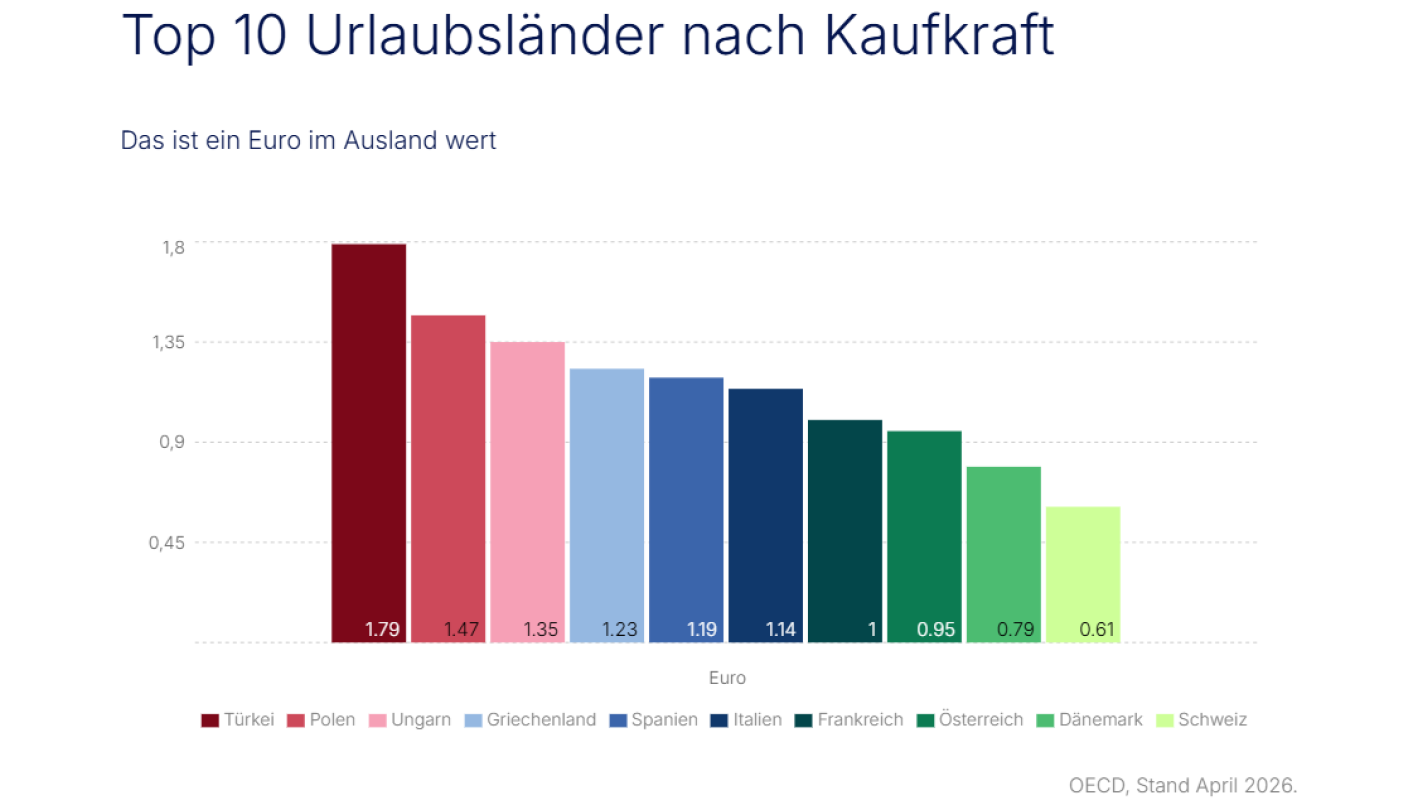
Top 10 Urlaubsländer nach Kaufkraft
Das ist ein Euro im Ausland wert
OECD, Stand April 2026
Best value-for-money: Türkiye, Hungary, Poland, Greece and Spain
The Türkiye, Poland and Hungary are the top holiday destinations in terms of purchasing power. In Türkiye, you’ll get almost twice the amount of goods and services for your money than you would in Germany.
You’ll also profit significantly from an increase in purchasing power in Poland. There, one euro will get you goods and services that would cost 1.47 euro in Germany. In Hungary, too, one euro stretches much further than it does in Germany. You’ll be able to get approximately one third more goods and services for each euro spent.
Prices in Greece are also lower, making it a great summer destination. Your purchasing power is worth just under a quarter more (23 percent). Spain is another financially attractive destination, with the euro stretching about 20 percent further (1.19 euro).
You’ll find similar price levels to Germany in Austria, France and Italy.
There, prices are only minimally different, making holidays in Austria, France and Italy comparable to staying in Germany. In France, prices are exactly level with German averages. In Austria, they are slightly higher, so you’ll receive about 5 percent less for your money. In Italy, you can get about 11 percent more for the same amount of money. But overall, your purchasing power stays roughly the same as that in Germany.
More expensive destinations: Denmark and Switzerland
A holiday in Denmark is significantly more expensive than one in Germany. This is because the purchas-ing power of one euro is worth only 79 cents in neighbouring Denmark, so you have around 21 percent less purchasing power. That means you can expect the cost of your holiday to be significantly more expensive. Switzerland is even more expensive; the purchasing power of one euro is worth only 61 cents. You’ll be able to get approximately one third fewer goods and services for each euro spent in Switzerland as compared to a euro spent in Germany.
The purchasing power of the euro abroad is calculated by comparing price levels, which vary depend-ing on the economic power and wage levels of a country. This also applies to countries in the euro-zone, even though there are no fluctuations due to exchange rates. If you want more information, the OECD publishes an international comparison of purchasing power.
Contact
Kathleen Altmann
Press spokeswoman