Do we really need more ESG data?
What the Omnibus Package means for risk management

Guest article by Torsten Jäger, Head of Sustainable Finance, published on Bank Blog on 15 July 2026.
The EU has launched a review of key ESG reporting requirements as part of its efforts to reduce the administrative burden on businesses. From a prudential perspective, however, requirements remain stringent, particularly with regard to data quality. How can these objectives be reconciled in practice?
Consider road safety: the risk of being killed in a traffic accident is around three to four times higher in India than in Germany. Yet many observers there would likely view Germany’s extensive system of road signs, 30 km/h zones and continually expanding safety requirements as excessive. The boundary between regulatory restraint and regulatory intervention is rarely clear-cut. In many cases, it is a matter of perspective.
This is precisely where ESG regulation in Europe finds itself today. Reducing bureaucracy is an objective that commands broad support. Yet opinions quickly diverge when it comes to determining the appropriate level of regulation.
More regulation, limited coordination
Since the EU Action Plan on Financing Sustainable Growth was launched in 2018, a substantial body of ESG regulation has emerged, including the EU Taxonomy, sustainability reporting requirements and rules governing risk management and disclosures. Taken together, these measures amount to more than 1,800 pages of regulatory text that companies and banks must analyse, interpret and, above all, implement. Good intentions, however, do not automatically translate into good regulation.
Zuwachs der Regulierung im Bereich ESG
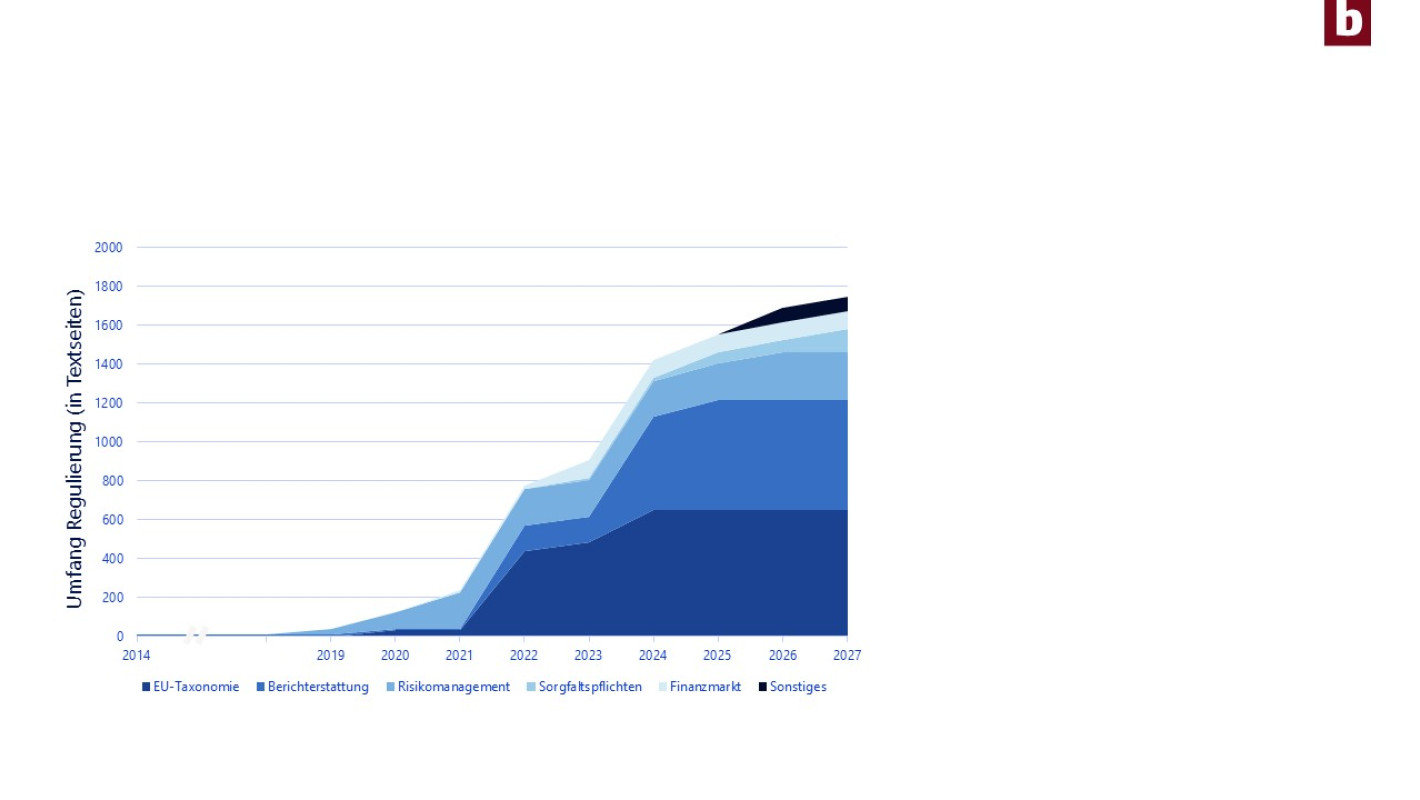
An honest assessment must therefore acknowledge that the sheer volume of regulation, the level of detail involved and the lack of alignment between individual requirements have, in some areas, caused regulation to overshoot its intended objective. Regulating every aspect in ever greater detail and requiring disclosures that may be relevant only to very specific stakeholder groups ties up resources that could be put to better use elsewhere. Ultimately, the compliance burden risks becoming so onerous that even organisations with ambitious sustainability goals are discouraged. This is why the current review and simplification of the regulatory framework is both justified and urgently needed.
Simplification without changing course
The objective of simplifying ESG regulation should not be misunderstood. This is not about ‘rolling back’ sustainability ambitions. We must continue to manage physical and transition risks, reduce dependence on fossil fuels, future-proof business models and effectively address global warming and biodiversity loss.
The impacts of climate change are already a reality. Munich Re estimates that natural disasters caused global losses of USD 224 billion last year, with around half of those losses uninsured. According to the World Economic Forum’s Global Risks Report 2026, five environmental risks rank among the world’s ten most severe long-term risks.
ESG risks and the “green swan”
Climate and environmental risks, as well as nature-related dependencies, remain highly relevant. At the same time, they differ fundamentally from traditional risk categories, with limited historical data, non-linear relationships, uncertain tipping points and exceptionally long time horizons. Enter the green swan.
Risk management is a core banking competence. Banks therefore have a strong inherent interest in measuring and effectively managing risks across the environmental (E), social (S) and governance (G) dimensions. In a survey conducted by the Association of German Banks, ESG risk management ranks among the most important drivers of sustainability, behind regulation but ahead of corporate responsibility.
Supervisory expectations remain high
Precisely because climate and environmental risks can have significant financial and potentially systemic implications, they remain a key focus of supervisors. With the entry into force of the Banking Directive Implementation and Bureaucracy Relief Act (BRUBEG), ESG risk requirements have also been formally embedded in Germany’s Banking Act (Kreditwesengesetz, KWG) since 1 April 2026. The EBA Guidelines, the ECB’s supervisory expectations and the Minimum Requirements for Risk Management (MaRisk) therefore continue to apply, subject to the principle of proportionality.
Even though the MaRisk framework is currently being streamlined and ESG requirements are being consolidated, the supervisory bar is not being lowered. On the contrary, supervisors are placing increasing emphasis on physical risks and nature-related dependencies, not least because these are still frequently underestimated. In the view of ECB Executive Board member Frank Elderson, who is responsible for European banking supervision, the journey is far from over. The ECB continues to identify gaps, particularly in the comprehensive coverage of portfolios, risk drivers and transmission channels. And although obtaining robust and reliable data, for example on companies’ greenhouse gas emissions and energy efficiency in the buildings sector, remains a major challenge, the message is clear: Banks are expected to continuously expand their base of actual data. The only question is: where are these data to come from?
Three routes to ESG data
1. Standardised corporate reporting
The most obvious source is companies’ verified and standardised sustainability reporting. This is precisely the objective of the Corporate Sustainability Reporting Directive (CSRD). Originally, around 47,000 companies across the EU were expected to submit reports from the 2025 financial year onwards. As part of the Omnibus initiative, however, the scope has been significantly reduced.
From 2027, only large companies with more than 1,000 employees and annual turnover exceeding EUR 450 million will remain subject to mandatory reporting requirements. As a result, the number of companies in scope will fall by around 92 percent. This leaves approximately 11,700 companies across the EU and around 1,300 in Germany subject to the reporting requirements. All other companies may report voluntarily under the VSME standard (to be renamed VS). Whether large numbers of companies will choose to do so remains to be seen.
2. Data collection through customer engagement
Where companies do not report, ESG data can be collected through direct engagement with customers or by means of questionnaires. A (non-representative) survey conducted by the Association of German Banks last year found that 66 percent of participating banks use questionnaires to gather ESG data. Among these banks, questionnaires were used exclusively for larger corporate clients in 21 percent of cases and only for selected sectors in 14 percent of cases. By contrast, 65 percent of respondents used questionnaires for all corporate clients.
To provide guidance on the data points typically required for risk management, reporting and strategic decision-making, the Association of German Banks, public-sector banks and insurance firms have jointly developed an ESG data catalogue.
3. Proxies and estimates
A third option is to rely on proxies and estimates. These can help to address data gaps in specific areas, but they are not a universal solution. Firstly, robust models depend on reliable underlying data. If data quality is poor from the outset, no estimate can compensate for that. Secondly, proxies can provide only limited meaningful information. For example, the greenhouse-gas intensity of a particular sector can serve as a useful indicator when assessing whether that sector is exposed to elevated climate risks. However, a bank needs to know how its customers and portfolios compare with the sector average in order for its risk management and strategic decision-making on sustainability to be more effective.
Quality over quantity
Reliable and comparable data are essential for effective risk management without placing unnecessary burdens on companies. Data collection should never become an end in itself. Three things are crucial here:
Firstly, work on the reporting standards (ESRS, VS(ME)) needs to be finalised quickly so that companies have a reliable basis for their reporting. Reporting standards must also focus on the data points that are relevant to key stakeholder groups.
Secondly, incentives are needed to encourage as many companies as possible to report voluntarily. Initiatives such as the German Sustainability Code (Deutschen Nachhaltigkeitskodex, DNK) provide valuable support in this respect. It is then important for companies to provide information from both modules of the VS(ME) wherever possible, as the additional module in particular contains key data points for banks, including greenhouse gas emissions and climate risks.
Thirdly, companies should view the collection and reporting of sustainability data as an opportunity to improve efficiency, manage their business models more effectively, strengthen resilience and remain competitive over the long term. Banks can support them on this journey as providers of finance, advisers and strategic partners.
Contact
Torsten Jäger
Head of Sustainable Finance